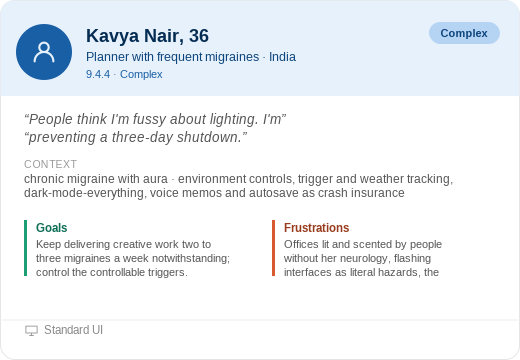
Kavya Nair
Planner with frequent migraines
India · South Asia · Age 36
- Law
- RPwD Act 2016
- Services
- Aadhaar / UMANG / UPI
- Messaging
Assistive Technology
- Standard UI
People think I'm fussy about lighting. I'm preventing a three-day shutdown.
Goals
Keep delivering creative work two to three migraines a week notwithstanding; control the controllable triggers.
Frustrations
Offices lit and scented by people without her neurology, flashing interfaces as literal hazards, the 'difficult colleague' tax.
Profile
Kavya Nair is an advertising planner who has migraines 2–3 times a week. She is sensitive to various triggers—light, sound, smell, stress. She does creative work, but when a migraine comes her thinking is paralyzed. At work she's sometimes mistaken for fussy, but it's really an effort to prevent migraines.
Technology Environment
- Trigger management: brightness control, blue-light blocking, noise cancellation
- Symptom tracking: migraine-diary app, weather alerts
- Work tools: dark mode, desaturated interface
- Contingency: voice memos, auto-save, backup plans
Daily Scenario
At 9 a.m., Kavya inspects her environment as soon as she reaches the office. She turns off the fluorescent lights and uses only a desk lamp, lowers her monitor brightness to 30%, and puts on blue-light glasses. She's received an alert that low barometric pressure makes migraine risk high today.
During a planning meeting, someone arrives wearing strong perfume. Kavya is instantly on edge. Within 10 minutes, zigzag lines (an aura) begin to appear in her vision—a migraine is coming.
// Kavya's migraine prevention and management system
const migraineManagementSystem = {
  triggerMonitoring: {
    environmental: {
      light: { intensity: 'max_300_lux', color_temp: 'warm_only', flicker_free: true, no_fluorescent: true },
      sound: { max_decibels: 50, white_noise: 'optional_masking', sudden_sounds: 'avoided' },
      smells: { fragrance_free_zone: true, ventilation: 'constant_fresh_air' }
    },
    digitalTriggers: {
      screen: { brightness: 'adaptive_30_50%', contrast: 'reduced', motion: 'minimal_animations', refresh_rate: 'flicker_free_monitor' },
      patterns: { high_contrast_stripes: 'avoided', flashing: 'absolutely_prohibited', busy_patterns: 'simplified' }
    }
  },
  attackProtocol: {
    prodrome_detected: {
      immediate_actions: ['take_abortive_medication', 'cancel_non_critical_meetings', 'delegate_urgent_tasks', 'move_to_dark_quiet_space'],
      work_handoff: { pre_written_templates: true, team_notification: 'automatic', project_status: 'always_updated' }
    },
    recovery: { gradual_return: '2_4_hours_post_attack', reduced_stimulation: '24_hours', catch_up_strategy: 'prioritized_task_list' }
  }
};
Kavya immediately takes a triptan and tells her manager. Fortunately the company has a rest room for migraine sufferers. She rests in the dark, quiet room for an hour.
At 4 p.m., with the migraine subsiding, Kavya cautiously returns to work. She switches every screen to her preset 'migraine mode'—grey text on a black background, no animation, muted.
Challenges & Strategies
- Unpredictable attacks: a migraine can strike at a critical moment. Kavya prepares all work in advance and makes real-time backups a habit.
- Limits of environmental control: she can't control every environment. Kavya always carries portable blocking tools and abortive medication.
- Fluctuating productivity: migraine aftereffects lower her efficiency for days. She analyzes her symptom patterns and strategically places important work.
Design Implications
- Minimize triggers: a calm interface with reduced visual stimulation.
- Quick mode switching: switch to low-stimulation mode in one click.
- Flexible saving: prevent work loss with auto-save and version control.
- Accessibility options: alternative interfaces such as voice and text.