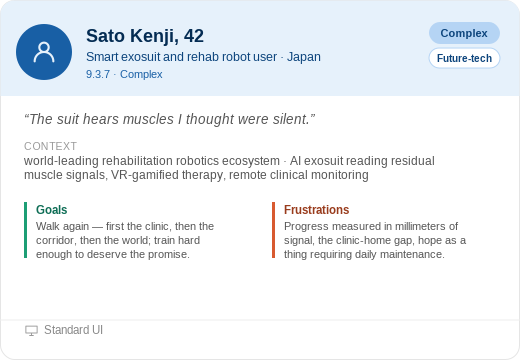
Sato Kenji
Smart exosuit and rehab robot user
Japan · East Asia · Age 42
- Law
- Barrier-Free Act · JIS X 8341-3
- Services
- MyNumber portal
- Messaging
- LINE
Assistive Technology
- Standard UI
The suit hears muscles I thought were silent.
Goals
Walk again — first the clinic, then the corridor, then the world; train hard enough to deserve the promise.
Frustrations
Progress measured in millimeters of signal, the clinic-home gap, hope as a thing requiring daily maintenance.
Profile
Sato Kenji became paraplegic after a spinal-cord injury in a construction-site accident five years ago. Recently he began rehabilitation wearing a cutting-edge smart exosuit (exoskeleton robot). The exosuit's AI detects his faint muscle signals to aid natural walking. He trains without boredom through VR and gamified rehab programs, holding the hope of walking again.
Technology Environment
- Smart exosuit: AI-based gait-pattern learning
- VR rehab: gamified physical-therapy program
- Biosignal monitoring: EMG, pressure sensors, posture analysis
- Remote rehab: expert monitoring even from home
Daily Scenario
At 10 a.m., Kenji puts on the exosuit at the rehab center. Sensors attach to his waist and legs, and the AI analyzes his residual muscle signals. "Shall we practice climbing stairs today?" the rehab robot suggests.
When he puts on the VR headset, a beautiful mountain trail unfolds. He's really on a treadmill, but in VR it feels like hiking. When the AI detects his intent to move his legs, the exosuit assists the movement.
// Kenji's smart-rehab system
const smartRehabSystem = {
  exosuitAI: {
    motorIntentDetection: { emgThreshold: 0.05, patternRecognition: 'deep_learning', personalization: 'continuous_adaptation' },  // detects even very faint signals
    movementAssistance: { supportLevel: 'progressive_reduction', gaitOptimization: 'natural_pattern_recovery', fallPrevention: 'predictive_balance_control' },
    feedback: { haptic: 'muscle_activation_cues', visual: 'real_time_biomechanics', audio: 'rhythmic_guidance' }
  },
  vrTherapy: {
    environments: [
      { name: 'mountain_trail', difficulty: 'adaptive', goals: 'endurance' },
      { name: 'city_walk', difficulty: 'moderate', goals: 'obstacle_navigation' },
      { name: 'beach_walk', difficulty: 'hard', goals: 'unstable_surface' }
    ],
    gamification: { achievements: 'distance_milestones', socialFeatures: 'compete_with_other_patients', rewards: 'unlock_new_environments' }
  },
  progressAnalytics: {
    metrics: { muscleActivation: 'increasing_trend', weightBearing: '65%_on_legs', autonomy: 'reduced_exosuit_assistance', neuralReconnection: 'detected_new_pathways' },
    prediction: { recoveryTimeline: 'personalized_forecast', nextMilestones: 'ai_recommended_goals' }
  }
};
After lunch, Kenji continues remote rehab at home. Wearing a lightweight version of the exosuit, he connects to a rehab coach via tablet. The coach monitors his movements in real time and guides him.
At 4 p.m., Kenji sets a new record in the rehab game—walking 1km in a virtual city! It's about 200m in reality, but his muscle activation has greatly improved. The AI tells him, "Your left quadriceps signal is 20% stronger."
In the evening, Kenji shares experiences with other exosuit users in an online community. He takes great hope from one user's news of walking 10 steps unaided after six months.
Future Impact
- Personalized rehab: the AI learns the individual's neural-signal patterns to provide tailored support. Even Kenji's tiny gains are precisely tracked.
- Motivation innovation: VR and gamification turn tedious rehab into an adventure. Kenji looks forward to his rehab time each day.
- Hope made real: neural reconnection once thought impossible is becoming possible with advanced technology. Kenji now holds a concrete hope of walking again.
Design Implications
- Ultra-precise signal detection: convert even faint biosignals into meaningful input.
- Adaptive support: assistance level that auto-adjusts to the recovery stage.
- Immersive motivation: enjoyable rehab using VR/AR.
- Data-driven hope: sustain motivation with concrete progress metrics.