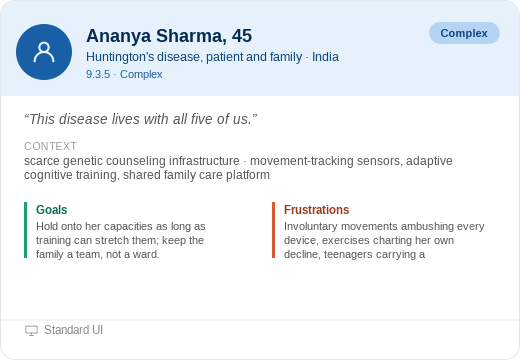
Ananya Sharma
Huntington's disease, patient and family
India · South Asia · Age 45
- Law
- RPwD Act 2016
- Services
- Aadhaar / UMANG / UPI
- Messaging
Assistive Technology
- Standard UI
This disease lives with all five of us.
Goals
Hold onto her capacities as long as training can stretch them; keep the family a team, not a ward.
Frustrations
Involuntary movements ambushing every device, exercises charting her own decline, teenagers carrying a fifty-percent question.
Profile
Ananya Sharma was diagnosed with Huntington's disease three years ago. She experiences chorea (involuntary movements), cognitive decline, and mood changes. A former financial analyst, she has stopped working to focus on treatment. Her husband Raj is the main caregiver, and their teenage children carry anxiety about the possibility of inheritance. The whole family uses digital tools to manage the disease and communicate.
Technology Environment
- Symptom management: movement-tracking sensors, cognitive-training app
- Family communication: shared calendar, care-journal app
- Safety: GPS tracking, fall detection, smart pillbox
- Emotional support: mood tracking, family-counseling platform
Daily Scenario
At 9 a.m., Ananya starts a cognitive-training app. They're simple puzzles and memory games, but feel harder than before. Suddenly her arm moves on its own and she nearly drops the tablet. Raj brings a stand fixed to the table.
// The Sharma family's integrated Huntington's-care system
const huntingtonsFamilyCare = {
  patientMonitoring: {
    movement: {
      sensors: ['wrist_accelerometer', 'video_analysis'],
      patterns: { chorea_intensity: 'scale_0_to_5', frequency: 'episodes_per_hour', triggers: ['stress', 'fatigue', 'medication_timing'] }
    },
    cognitive: {
      dailyExercises: { difficulty: 'adaptive', duration: 'fatigue_based', domains: ['memory', 'attention', 'executive_function'] },
      declineTracking: { baseline: '2021_assessment', monthly_comparison: true, alert_threshold: '20%_decline' }
    },
    emotional: { moodSwings: 'hourly_check_in', irritability: 'family_reported', depression: 'phq9_weekly' }
  },
  familySupport: {
    caregiverTools: { respite_scheduling: 'automated_reminders', stress_monitoring: 'caregiver_wellbeing_app', education: 'stage_specific_resources' },
    childrenSupport: { age_appropriate_info: true, genetic_counseling: 'scheduled', peer_support_groups: 'teen_HD_community' },
    communication: { shared_journal: 'family_care_log', emergency_protocols: 'one_touch_alert', positive_moments: 'gratitude_sharing' }
  }
};
After lunch, Ananya experiences a sharp mood swing—angry over something trivial, then suddenly bursting into tears. Raj logs the episode in a mood-tracking app, planning to analyze the pattern and reference it when consulting the doctor.
At 4 p.m. is the family meeting. Their eldest son asks, "Mum, should I get genetic testing too?" It's a heavy topic but unavoidable. Ananya's speech has slurred, but she slowly conveys her thoughts. They book an expert via a family-counseling app.
In the evening, Ananya joins an online Huntington's patient group, finding comfort talking with people in similar situations. Typing is hard so she mostly listens, but expresses empathy with emoji.
Challenges & Strategies
- Managing complex symptoms: physical, cognitive, and emotional symptoms appear together. The family tracks all symptoms with an integrated app and identifies correlations.
- Impact on the whole family: not just the patient but everyone is affected. They use support tools tailored to each family member.
- Future uncertainty: how the disease will progress, and whether children inherited it, is unknown. The family makes stage-based contingency plans and updates them regularly.
Design Implications
- Family-centered design: features for caregiving family members, not just the patient.
- Respond to symptom variability: account for unpredictable movement and cognitive change.
- Long-term view: stage-based support as the disease progresses.
- Emotional connection: strengthen family bonds beyond technical features.