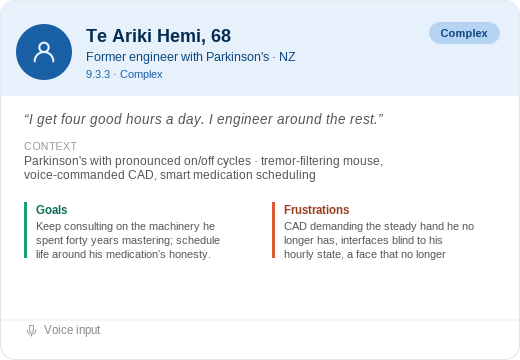
Te Ariki Hemi
Former engineer with Parkinson's
NZ · Oceania · Age 68
- Law
- Human Rights Act · NZ Web Standards
- Services
- RealMe
- Messaging
- WhatsApp · Messenger
Assistive Technology
- Voice input
I get four good hours a day. I engineer around the rest.
Goals
Keep consulting on the machinery he spent forty years mastering; schedule life around his medication's honesty.
Frustrations
CAD demanding the steady hand he no longer has, interfaces blind to his hourly state, a face that no longer broadcasts meaning.
Profile
Te Ariki Hemi is a former mechanical engineer diagnosed with Parkinson's disease five years ago. Hand tremor, rigidity, and bradykinesia (slowness of movement) are gradually progressing. He wants to continue technical consulting in retirement, but precise drafting work has become hard. The difference between medication 'on' time and 'off' time is large. With a strong grasp of technology, he actively tries various assistive tools.
Technology Environment
- Tremor compensation: stabilizing mouse, weighted stylus
- Voice control: smart speaker, voice-command CAD
- Movement support: smart walker, freezing-of-gait device
- Medication: smart pillbox, medication-reminder system
Daily Scenario
At 7 a.m., Te Ariki takes his first medication on waking. For 30 minutes until it takes effect, his movements are very slow. He says to the smart speaker, "Tell me today's schedule,"—operating a phone by hand is too hard with his tremor.
At 10 a.m. is the 'on' time when the medication peaks. Te Ariki uses this window for CAD work. A special mouse compensates for his hand tremor, but precise work is still hard. He works by voice command: "Draw a line, start point coordinates 100, 200."
// Te Ariki's Parkinson's adaptive-tech system
const parkinsonAdaptiveTech = {
  tremorCompensation: {
    mouseSettings: { filterLevel: 'high', smoothingAlgorithm: 'kalman_filter', clickAssist: 'dwell_click', magneticTargets: true },
    writingSupport: { device: 'weighted_stylus_pen', digitizer: 'tremor_canceling_tablet', strokePrediction: true, autoSteady: 'end_point_hold' }
  },
  medicationSync: {
    schedule: [
      { time: '07:00', medication: 'Levodopa', reminder: 'voice+vibration' },
      { time: '11:00', medication: 'Levodopa', reminder: 'voice+vibration' },
      { time: '15:00', medication: 'Levodopa', reminder: 'voice+vibration' },
      { time: '19:00', medication: 'Levodopa', reminder: 'voice+vibration' }
    ],
    efficacyTracking: { onPeriods: 'motion_sensor_detection', offPeriods: 'auto_logged', optimization: 'suggest_timing_adjustments' }
  },
  freezingOfGait: { detection: 'accelerometer_pattern', interventions: ['rhythmic_auditory_cue', 'visual_laser_line', 'vibrotactile_prompt'] }
};
At 2 p.m., as 'off' time begins, his movements slow. Heading to the bathroom, his feet suddenly freeze at the doorway (freezing of gait). The smart walker detects it and emits a rhythmic beep; walking to the sound, he can move again.
At 6 p.m., Te Ariki joins an online Parkinson's patient group. On the video call, his facial expression is rigid (masked face), making emotional expression hard. Instead he makes active use of emoji and hand gestures, and trades information about new assistive technologies with other patients.
Challenges & Strategies
- Variability of movement: his state changes greatly within a day. Te Ariki packs important work into 'on' time and does passive activities during 'off' time.
- Loss of fine motor control: precise engineering work has become hard. He maintains accuracy through voice commands and coordinate entry.
- Limited expression: reduced facial expression and gesture cause misunderstandings. He relies on clear verbal expression and digital aids.
Design Implications
- State-aware system: detect and respond to the user's current motor state.
- Tremor filtering: algorithms distinguishing intentional movement from tremor.
- Timing optimization: schedule important work in optimal windows.
- Alternative precise input: ensure accuracy via voice, numeric entry, etc.