Layla Haddad
MS with fluctuating symptoms
UAE · MENA · Age 41
- Law
- Federal Law No. 29/2006
- Services
- UAE PASS
- Messaging
Assistive Technology
- Keyboard
- Audio
- Voice input
- Eye tracking
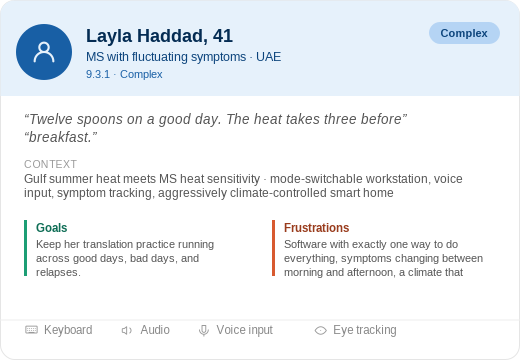
Twelve spoons on a good day. The heat takes three before breakfast.
Goals
Keep her translation practice running across good days, bad days, and relapses.
Frustrations
Software with exactly one way to do everything, symptoms changing between morning and afternoon, a climate that taxes her condition.
Profile
Layla Haddad is a freelance translator diagnosed with multiple sclerosis 10 years ago. With relapsing-remitting MS, her symptoms change unpredictably. On good days she can work almost normally; on bad days she experiences severe fatigue, blurred vision, and hand tremor. She switches among various assistive tools to suit the situation and makes energy management her top priority.
Technology Environment
- Adaptive workstation: height-adjustable desk, varied input devices
- Voice recognition: Dragon NaturallySpeaking (used on tired days)
- Symptom tracking: MS-diary app, wearable activity monitor
- Environment control: smart home (auto-adjusting temperature, lighting)
Daily Scenario
At 7 a.m., Layla assesses her state for the day. Her hands tremble slightly and her left leg is numb—a moderate day. She logs the symptoms in her MS-tracking app and decides to rely mainly on voice input today.
About to start a translation, the screen looks blurry—optic neuritis may have recurred. Layla turns on screen magnification and switches to high-contrast mode. Still struggling, she enables text-to-speech to read the text aloud.
// Layla's MS adaptive workspace
const msAdaptiveWorkspace = {
  symptomBasedModes: {
    good_day:     { input: 'keyboard', display: 'normal', workDuration: '2-hour-blocks', breakReminder: 'gentle' },
    moderate_day: { input: ['voice', 'stylus'], display: 'high_contrast_enlarged', workDuration: '45-min-blocks', breakReminder: 'strict' },
    bad_day:      { input: 'voice_only', display: 'audio_primary', workDuration: '20-min-blocks', breakReminder: 'enforced' },
    relapse:      { mode: 'minimal_essential_only', delegation: 'auto_forward_urgent' }
  },
  energyManagement: {
    spoonTheory: {
      dailySpoons: 12,   // varies by day
      taskCost: { 'typing_1hour': 2, 'voice_dictation_1hour': 1, 'video_call_30min': 3, 'email_checking': 1 },
      tracking: 'real_time_depletion'
    }
  },
  predictiveSupport: { patternAnalysis: 'identify_triggers', preemptiveAdjustments: true, weatherCorrelation: true, stressMonitoring: 'hrv_based' }
};
At 2 p.m., severe fatigue suddenly hits, and the cognitive dip known as 'MS fog' begins. Layla stops working and sets a 20-minute rest timer. The smart-home system automatically lowers the room temperature and dims the lights.
In the evening, Layla remembers she has a client meeting tomorrow, but she can't predict tomorrow's condition. She asks whether it can be changed from video to email, and just in case prepares the presentation as a voice recording too.
Challenges & Strategies
- Unpredictability: she can be fine in the morning and suddenly worse in the afternoon. Layla always prepares a plan B and shares her situation honestly with clients.
- Fluctuating cognition: her focus and memory come and go. She records everything and breaks work into small units.
- Cumulative loss of function: sometimes she doesn't fully recover after a relapse. Layla learns new assistive technologies in advance and adjusts her working methods gradually.
Design Implications
- Extreme flexibility: multiple access methods for every function.
- State-based automation: auto-adjust the interface to symptoms.
- Energy-efficient design: maximum effect with minimal action.
- Graceful degradation: keep core functions even as ability declines.