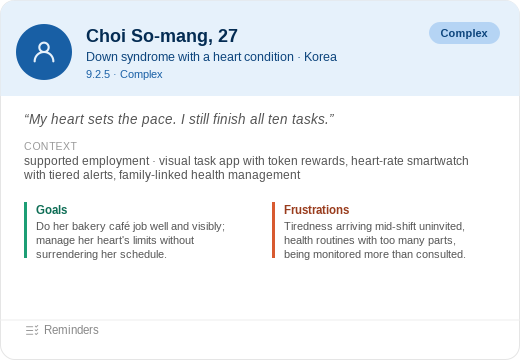
최소망 · Choi So-mang
Down syndrome with a heart condition
Korea · East Asia (Korea) · Age 27
- Law
- 장차법 · KWCAG 2.2
- Services
- 정부24 / 카카오·토스
- Messaging
- KakaoTalk
Assistive Technology
- Reminders
My heart sets the pace. I still finish all ten tasks.
Goals
Do her bakery café job well and visibly; manage her heart's limits without surrendering her schedule.
Frustrations
Tiredness arriving mid-shift uninvited, health routines with too many parts, being monitored more than consulted.
Profile
Choi So-mang has both Down syndrome and a congenital heart condition. She graduated from a special school and now works at a bakery café. Sociable and positive, she has physical limits due to her heart condition. She uses a picture- and icon-based work-support app and monitors her health with a smartwatch.
Technology Environment
- Work support: visual task-instruction app, timer
- Health monitoring: heart-rate smartwatch
- Communication: picture-based messenger, video calls
- Leisure: easy games, music streaming
Daily Scenario
At 8 a.m., So-mang gets ready for work. Her smartwatch tells her today's heart rate is higher than usual—she seems tired from watching her favorite drama late last night. She lets her mum know and packs extra heart medication.
Arriving at the café, So-mang checks today's tasks on her tablet. 'Display bread,' 'wipe tables,' and 'empty the bins' are shown in pictures. She checks off each completed task; finishing 10 earns a praise sticker.
// So-mang's integrated health-work management system
const downsWorkHealthSystem = {
  healthMonitoring: {
    heartRate: {
      resting: { min: 60, max: 80 },
      working: { min: 70, max: 110 },
      alerts: {
        mild: { threshold: 120, action: 'rest_reminder' },
        moderate: { threshold: 140, action: 'stop_work_alert' },
        severe: { threshold: 160, action: 'emergency_contact' }
      }
    },
    fatigueDetection: { factors: ['heart_rate_variability', 'step_count', 'active_hours'], recommendations: 'adaptive_break_schedule' }
  },
  workSupport: {
    taskList: {
      presentation: 'visual_cards',
      difficulty: 'graduated',   // start with the easy ones
      rewards: 'token_system',
      adaptiveScheduling: function (healthStatus) {
        if (healthStatus.fatigue > 0.7) return this.reduceTasks(['heavy_lifting', 'fast_paced']);
        return this.normalSchedule();
      }
    },
    instructions: { format: 'step_by_step_images', text: 'simple', audio: 'optional_guidance' }
  }
};
At lunch, So-mang eats with colleagues. Mid-conversation she suddenly feels short of breath. Her smartwatch vibrates with the message "You need a rest." So-mang excuses herself and rests quietly for five minutes.
In the afternoon, So-mang does her favorite job—packaging cookies. It's repetitive, but she takes pride in doing it precisely. The tablet app congratulates her: "100 done! Amazing!" But standing a long time makes her legs swell.
After work, So-mang reports her day to her mum, and they look together at the health report the smartwatch app generated automatically. Confirming "Today your heart rate rose three times, but you rested well so it was fine," she feels reassured.
Challenges & Strategies
- Imbalance of stamina and motivation: she wants to do a lot, but her heart can't keep up. So-mang is learning to rest appropriately by following her smartwatch's alerts.
- Complex health management: remembering medication, activity limits, and regular check-ups is hard. So-mang's family manages it together with an integrated health app.
- Balancing independence and protection: she wants to work independently but needs ongoing monitoring for her health. Smart devices let her keep autonomy while staying safe.
Design Implications
- Health-first adaptive system: adjust activity to real-time health status.
- Positive reinforcement: immediate, visual reward even for small achievements.
- Simple but respectful interface: balance ease of use with an adult-appropriate design.
- Family-linked features: caregiver monitoring without undermining independence.