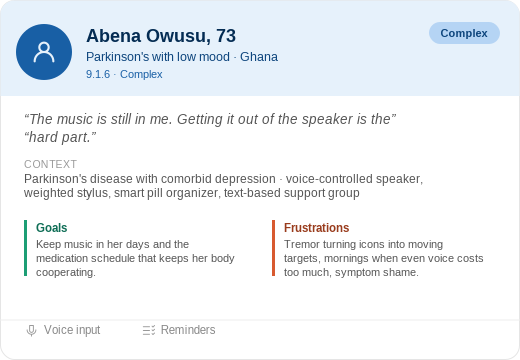
Abena Owusu
Parkinson's with low mood
Ghana · Africa · Age 73
- Law
- Persons with Disability Act 715
- Services
- Ghana.gov / MoMo
- Messaging
Assistive Technology
- Voice input
- Reminders
The music is still in me. Getting it out of the speaker is the hard part.
Goals
Keep music in her days and the medication schedule that keeps her body cooperating.
Frustrations
Tremor turning icons into moving targets, mornings when even voice costs too much, symptom shame.
Profile
Abena Owusu was diagnosed with Parkinson's disease five years ago, since when her movements have gradually slowed and her hand tremor has worsened. Depression also developed, for which she takes medication. A retired middle-school music teacher, she seeks comfort in music, but with trembling hands, operating a music app—let alone playing an instrument—isn't easy.
Technology Environment
- Voice control: AI speaker, voice-command smart home
- Tremor compensation: weighted stylus, stabilization software
- Emotional support: meditation app, online support groups
- Medication: smart pillbox with reminders
Daily Scenario
At 8 a.m., Abena gets a reminder to take her medicine. But it's a heavily depressed day and she doesn't even want to get out of bed. The AI speaker announces, "It's time for your medication," but all she wants is to ignore it. In the end she takes it late, and her Parkinson's symptoms worsen all day.
At 11 a.m., feeling a little better, she wants to hear her favorite music. She tries to open a music app on the tablet, but trembling hands make it hard to touch the small icons accurately. After several tries, the wrong app opens. In frustration she shoves the tablet away.
# Integrated symptom-management and emotional-support system for Abena
class ParkinsonDepressionSupport:
    def __init__(self):
        self.tremor_compensation = {
            'touch_target_size': '20mm',     # 2x standard
            'dwell_time': 1.5,               # dwell 1.5s = click
            'tremor_filter': True,           # tremor-filtering algorithm
            'gesture_simplification': True   # simplify complex gestures
        }
        self.mood_support = {
            'daily_check_in': {'time': '09:00', 'method': 'voice', 'options': ['very good', 'good', 'okay', 'low', 'very low']},
            'interventions': {'music_therapy': 'mood_based_playlist', 'social_connection': 'connect_support_group', 'gentle_reminder': 'medication_encouragement'}
        }
        self.medication_adherence = {
            'reminders': 'multimodal',       # sound, light, vibration
            'motivation': 'personalized',    # "Take your medicine first, then enjoy the music"
            'tracking': 'automatic'          # linked to smart pillbox
        }
In the afternoon she joins an online Parkinson's patient group. It's a video chat, but she finds showing her face a burden and keeps the camera off. Hearing others' stories comforts her, but she also worries about her own future. She wants to write in the chat, but with trembling hands typing is hard, so she mostly just listens.
In the evening, Abena tries to log the day's state in a mood-diary app. But rating her mood on a 1–10 scale feels impossible—there are complex feelings that can't be put into a number. In the end she leaves only a voice memo: "Hard again today. I miss music."
Challenges & Strategies
- Vicious cycle of motor symptoms and mood: the more depressed, the more she delays medication, and skipping doses worsens symptoms and deepens depression. Abena found that an encouraging call from family helps her take her medicine.
- Giving up operation due to tremor: after several failures she gives up easily. She mainly uses voice commands, but when depressed she doesn't even want to speak.
- Social isolation: ashamed of visible symptoms, she avoids in-person gatherings, and even online she participates passively. She prefers text-based anonymous chat.
Design Implications
- Tremor-compensation technology: algorithms that distinguish intentional movement from tremor.
- Flexible emotion recognition: beyond numeric ratings—color, emoji, voice-tone analysis.
- Motivation strategies: personalized nudges, positive feedback for small wins.
- Lower resistance: perform core functions with minimal interaction.