Nour Khalil
Social worker with vicarious trauma
Egypt · MENA · Age 46
- Law
- Law 10/2018 on the Rights of PWD
- Services
- Digital Egypt
- Messaging
Assistive Technology
- Reminders
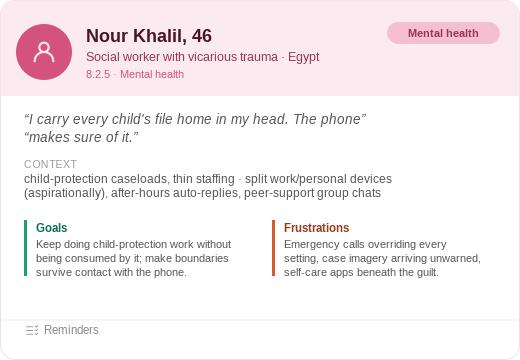
I carry every child's file home in my head. The phone makes sure of it.
Goals
Keep doing child-protection work without being consumed by it; make boundaries survive contact with the phone.
Frustrations
Emergency calls overriding every setting, case imagery arriving unwarned, self-care apps beneath the guilt.
Profile
Nour Khalil is a child-protection social worker with 15 years' experience, helping children who have suffered abuse. Continually encountering trauma cases, she experiences vicarious trauma. She empathizes excessively with others' suffering, and work-related content stays in her mind after hours. She struggles to set digital boundaries.
Technology Environment
- Work separation: attempts to separate work and personal devices
- Notification management: blocks work alerts outside hours
- Self-care: meditation app, exercise tracking, sleep monitoring
- Boundary tools: auto-reply, do-not-disturb mode
Daily Scenario
Friday morning, Nour reviews a new child-abuse case file. Seeing the digitally transmitted photos and report, her heart grows heavy. She tries to keep professional objectivity, but it hurts every time she sees a photo of the child's injuries.
At lunch, she runs a meditation app to compose herself. But in under five minutes an urgent call comes on the work phone—another crisis case. She stops meditating and responds at once.
// Nour's attempts at digital boundaries
const boundarySettings = {
  workLifeSeparation: {
    devices: { workPhone: 'on only during work hours (fails)', personalPhone: 'no work apps installed (partly fails)', laptop: 'work access limited by VPN' },
    notifications: { afterHours: 'auto-reply set', weekends: 'urgent contact only', vacation: 'cover-worker notice' },
    reality: { emergencies: '24/7 response needed', guilt: 'guilt if I don\'t answer', boundaries: 'often collapse' }
  },
  selfCareDigital: {
    apps: ['Headspace - used once a week', 'Fitbit - ignore stress alerts', 'journal app - full of trauma content'],
    copingStrategies: { positive: 'nature-sounds app for sleep', negative: 'searching case-related news', attempted: 'social-media detox (gave up after 3 days)' }
  },
  supportSystem: { supervisionApp: 'supervision scheduling', peerSupport: 'peer-counseling group chat', therapy: 'online counseling (irregular)' }
};
In the afternoon, Nour organizes digital evidence to submit to court. She repeatedly listens to messages and audio files documenting abuse while writing her report. It's past quitting time, but she keeps working, thinking, "If I write it just a bit more precisely, it'll help the child."
At 9 p.m., home, Nour tries to have personal time, but she can't turn off the work phone. "What if an emergency comes up?" In the end she sits on the sofa watching TV with the work phone beside her.
Before sleep, the cases she saw today won't leave her mind. She turns on a sleep-inducing app, but the children's faces keep surfacing. In the end she takes a sleeping pill and barely falls asleep.
Challenges & Strategies
- Emotional overload: continually encountering others' trauma exhausts her emotionally. Nour keeps an emotion journal to monitor her state.
- Failed digital boundaries: the digital boundary between work and personal life is blurred. She makes a 'digital boundary pledge' with colleagues to hold each other to it.
- Guilt and responsibility: she feels pressure to always be on call. She consults her supervisor to reset a realistic work scope.
- Self-care failure: she can't make proper use of self-care tools. She reminds herself of the principle that "I must care for myself first to care for others."
Design Implications
- Enforced breaks: automatically limit access after a set time.
- Emotion monitoring: a system that tracks and warns about the user's emotional state.
- Team boundaries: tools to set digital boundaries at an organizational level.
- Trauma-informed design: safeguards for content carrying secondary-trauma risk.