James Holloway
Veteran with PTSD
USA · North America · Age 50
- Law
- ADA · Section 508
- Services
- Login.gov / state portals
- Messaging
- iMessage · WhatsApp
Assistive Technology
- Switch
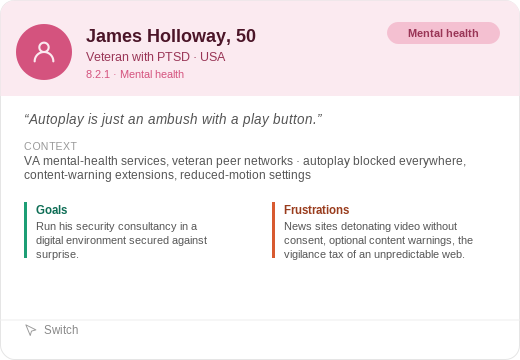
Autoplay is just an ambush with a play button.
Goals
Run his security consultancy in a digital environment secured against surprise.
Frustrations
News sites detonating video without consent, optional content warnings, the vigilance tax of an unpredictable web.
Profile
James Holloway is a veteran of 25 years' service living with PTSD from combat. He has severe trigger reactions to sudden loud sounds, bright flashes, and war-related imagery. He now works as a security consultant and tries to control unexpected stimuli in digital environments as much as possible.
Technology Environment
- Browser settings: autoplay blocked, animations disabled
- Media filters: content-warning extensions
- Sound control: noise cancellation, volume limiter
- Security settings: VPN, anonymous browsing (hypervigilance)
Daily Scenario
Monday at 10 a.m., James is writing a security-analysis report for a client. Visiting a news site for reference, a war-related breaking-news clip suddenly autoplays. With an explosion sound and a combat scene on screen, James momentarily feels yanked back to the past.
His heart races and he breaks into a cold sweat. He immediately closes the laptop and steadies his breathing. As trained, he checks his surroundings: "It's 2024, I'm safe in my own office."
// James's digital-safety settings
const ptsdSafetySettings = {
  browserConfig: { autoplay: 'blocked_all_sites', animations: 'prefers-reduced-motion', notifications: 'disabled', popups: 'strictly_blocked' },
  contentFilters: {
    keywords: ['war', 'explosion', 'gunfire', 'military'],
    imageFilter: 'blur_potentially_disturbing',
    videoPreview: 'static_thumbnail_only',
    soundSettings: 'gradual_volume_increase'
  },
  triggerManagement: { warningSystem: 'content_warning_extension', safeMode: 'text_only_option', quickExit: 'panic_button_enabled', recoveryTools: 'breathing_app_shortcut' },
  workEnvironment: { screenPosition: 'back_to_wall', exitRoutes: 'always_visible', lightingControl: 'no_sudden_changes', soundproofing: 'white_noise_machine' }
};
Once calm, James rechecks his browser settings—the autoplay block doesn't seem to have worked. He searches for and installs a stronger content-blocking extension.
In an afternoon video meeting, a colleague shares their screen and suddenly plays a loud video. James reflexively removes his earphones and looks away. He politely requests, "Sorry, could you let us know before playing a video?"
In the evening, James joins a PTSD online support group, comfortable being able to participate anonymously. He shares today's trigger experience and hears other veterans' coping methods. He decides to download a 'trauma-sensitive browser' someone recommended.
Challenges & Strategies
- Unpredictable triggers: sudden exposure to online content provokes re-experiencing. James blocks all autoplay where possible and prefers platforms with content warnings.
- Hypervigilance: he continually scans for threats even in digital environments. Excessive security settings sometimes make routine online activity inconvenient.
- Tendency to isolate: he limits online social activity to avoid triggers, joining only small communities he's verified as safe.
- Sleep problems: using devices at night raises his arousal. After 9 p.m. he applies a blue-light filter and dark mode to all devices.
Design Implications
- Content warnings: clear advance warnings for potentially triggering content.
- User control: full control over autoplay, sound, and animation.
- Gradual exposure: the ability to reveal content step by step.
- Safe exit: quickly close content and return to a safe screen.