Carmen Soto
Job seeker with social anxiety
Mexico · Latin America · Age 29
- Law
- Ley General de Inclusión
- Services
- gob.mx
- Messaging
Assistive Technology
- Standard UI
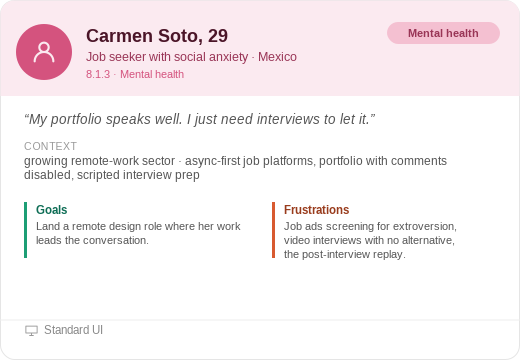
My portfolio speaks well. I just need interviews to let it.
Goals
Land a remote design role where her work leads the conversation.
Frustrations
Job ads screening for extroversion, video interviews with no alternative, the post-interview replay.
Profile
Carmen Soto is a graphic designer who recently left her job because social anxiety disorder made working in an office difficult. She is extremely sensitive to others' gaze and judgment and avoids face-to-face situations. She's looking for an online portfolio role with remote work, but even a video interview is a major challenge.
Technology Environment
- Job search: prefers remote-work-focused sites
- Portfolio: online portfolio (comments disabled)
- Communication: email and text mainly
- Social media: private accounts or deleted
Daily Scenario
Wednesday at 10 a.m., Carmen browses job sites. She finds an appealing listing but gives up applying when she sees "lively personality who values teamwork." Instead she searches keywords like "autonomous work environment" and "prefers asynchronous communication."
A startup requests a video interview after reviewing her portfolio. Carmen feels extreme anxiety. For three days before the interview she sleeps poorly and writes out likely questions and answers as a script.
# Carmen's video-interview prep script
interview_prep = {
    "self_intro": {
        "script": "Hello, I'm Carmen Soto, a graphic designer with 5 years of experience...",
        "duration": "30 seconds",
        "backup": "If I freeze: 'Let me show you my portfolio'"
    },
    "environment_setup": {
        "camera": "angle so only my face shows",
        "background": "maximum blur",
        "lighting": "backlight to reduce facial detail",
        "audio": "mute shortcut ready"
    },
    "contingency": {
        "connection_issue": "turn off video, blaming connection",
        "panic_attack": "say I'm getting water, and calm down",
        "blank_mind": "switch to sharing the prepared portfolio"
    }
}
On the day, Carmen waits from 30 minutes early. The moment the camera turns on, her face burns and her voice trembles. When the interviewer says "Just relax," she only tenses more. She's stuck her script beside the monitor, but worried her gaze will look unstable, she can barely glance at it.
After the interview, Carmen feels utterly drained. She replays everything she said and did—"Did I seem strange?" "Was my voice too quiet?" In the end, unable to wait for the company's follow-up, she sends an email withdrawing her application.
Challenges & Strategies
- Avoiding face-to-face interaction: she extremely dislikes video meetings and phone calls. Carmen looks for companies that allow text-based communication, but the options are limited.
- Over-awareness of self-image: she worries excessively about how she looks on video. She wants to turn off the camera but can't during an interview.
- Fear of negative feedback: she's reluctant to share her portfolio and takes critiques of her work as personal attacks. She prefers anonymous feedback systems.
- Difficulty networking: industry networking events and online communities are hard to join. She seeks 1:1 mentoring or small groups.
Design Implications
- Asynchronous options: respond over time rather than in live conversation.
- Gradual exposure: a progressive path from text to voice to video.
- Anonymity: an option to participate without revealing one's real name.
- Sense of control: fine-grained control over camera, mic, and screen sharing.