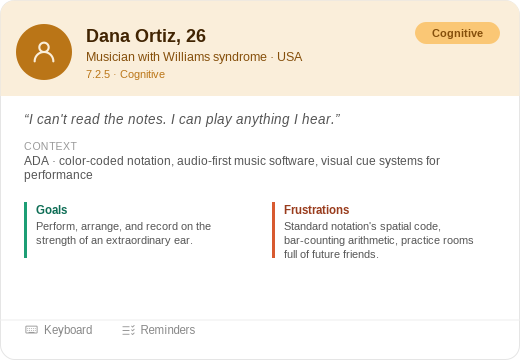
Dana Ortiz
Musician with Williams syndrome
USA · North America · Age 26
- Law
- ADA · Section 508
- Services
- Login.gov / state portals
- Messaging
- iMessage · WhatsApp
Assistive Technology
- Keyboard
- Reminders
I can't read the notes. I can play anything I hear.
Goals
Perform, arrange, and record on the strength of an extraordinary ear.
Frustrations
Standard notation's spatial code, bar-counting arithmetic, practice rooms full of future friends.
Profile
Dana Ortiz is a pianist with Williams syndrome. As typical of the syndrome, she shows outstanding musical talent and sociability but has difficulty with visuospatial perception and mathematical thinking. She has perfect pitch and can instantly play a melody she's heard once. She composes and performs using digital music tools.
Technology Environment
- Music production: GarageBand, color-coded score app
- Practice: speed-adjustable accompaniment app
- Performance prep: visual cue system, digital scores
- Daily life: GPS navigation, voice guidance
Daily Scenario
Tuesday morning, Dana is arranging a new piece. Reading the score is hard, but she uses a color-coded note system—C is red, D orange, E yellow… In GarageBand she marks each track the same colors for easy distinction.
# Dana's music-support system
class MusicAccessibilitySystem:
    def __init__(self):
        self.notation_support = {
            'color_coding': {'C': '#FF0000', 'D': '#FF7F00', 'E': '#FFFF00', 'F': '#00FF00',
                             'G': '#0000FF', 'A': '#4B0082', 'B': '#9400D3'},
            'simplified_notation': True, 'audio_playback': True, 'tempo_adjustment': 'variable'
        }
        self.spatial_aids = {
            'keyboard_guides': 'color_stickers', 'finger_position_hints': True,
            'visual_metronome': 'large_pendulum', 'measure_markers': 'bold_lines'
        }
        self.performance_support = {
            'cue_system': {'visual_cues': 'color_flash', 'audio_cues': 'count_in', 'haptic_feedback': 'metronome_vibration'},
            'anxiety_management': {'breathing_guide': True, 'positive_affirmations': True, 'familiar_playlist': True}
        }

    def navigation_assistance(self):
        """Getting to a venue or practice room."""
        return {'turn_by_turn': 'audio_only', 'landmarks': 'photo_based', 'arrival_confirmation': 'building_photo', 'emergency_contact': 'one_touch'}
"I want this part to feel a little brighter." Dana knows it exactly by ear but gets confused about which chord to use. She opens a chord-suggestion app, enters the current melody, and fitting chords are presented along with their colors.
In the afternoon she prepares for next week's performance. The route to the venue is complicated and worrying. Dana uses voice-only navigation, preferring landmark-based guidance like "after Starbucks, the next building" over spatial directions like "turn right at the big intersection."
In her evening practice, Dana plays along with the accompaniment app. Her current spot in the score is highlighted in bright yellow as it follows along. For hard passages she lowers the speed to 50% and practices slowly. When she makes a mistake, the app encourages her: "It's okay, try again!"
Challenges & Strategies
- Visuospatial difficulty: note positions on the score and keys on the keyboard are hard to locate. Dana uses the color system and tactile markers (stickers).
- Numerical concepts: counting beats and measures is hard. She uses a visual/auditory metronome and automatic measure markers.
- Excessive sociability: she'd rather chat than focus on practice. Dana sets a 'focus mode' during designated practice time.
Design Implications
- Audio first: an option to convert visual information into sound.
- Color coding: simplify complex information with color.
- Landmark-based: use concrete targets rather than spatial information.
- Positive feedback: encouraging messages even on mistakes.