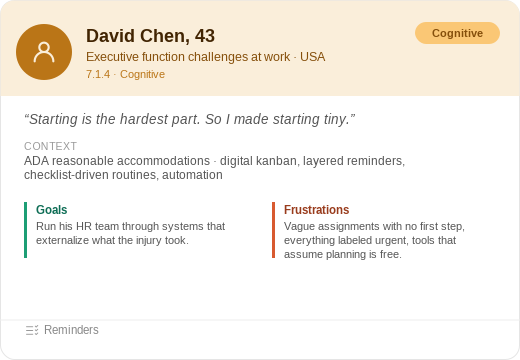
David Chen
Executive function challenges at work
USA · North America · Age 43
- Law
- ADA · Section 508
- Services
- Login.gov / state portals
- Messaging
- iMessage · WhatsApp
Assistive Technology
- Reminders
Starting is the hardest part. So I made starting tiny.
Goals
Run his HR team through systems that externalize what the injury took.
Frustrations
Vague assignments with no first step, everything labeled urgent, tools that assume planning is free.
Profile
David Chen is the HR head at a mid-sized company, with executive-function challenges following a concussion. Planning, prioritizing, and starting or switching tasks are hard, but he performs successfully through systematic tools and routines. His excellent memory for detail and his empathy are strengths.
Technology Environment
- Planning: digital kanban boards, Gantt charts
- Reminders: layered reminders, visual alarms
- Task breakdown: checklist apps, step-by-step guides
- Routine support: automation tools, IFTTT
Daily Scenario
Monday at 8:30 a.m., David reaches the office and starts his set routine. First he opens the "Morning Start Checklist": [ ] Turn on computer [ ] Check email [ ] Review today's schedule [ ] Pick top 3 priorities. He begins the day checking each item off.
// David's executive-function support system
const executiveFunctionSupport = {
  taskInitiation: {
    startupRoutines: {
      morning: ['email', 'calendar', 'priorities'],
      projectStart: ['confirm goal', 'gather materials', 'start first step']
    },
    motivationalPrompts: true,
    visualCountdown: '3-2-1 go!'
  },
  taskBreakdown: {
    maxStepsDisplay: 5,            // show at most 5 steps at once
    currentStepHighlight: true,
    completionFeedback: 'Well done!',
    nextStepPrompt: 'Move to the next step?'
  },
  transitionSupport: {
    warningTime: 10,              // alert 10 minutes ahead
    transitionRoutine: ['save current work', 'write a note', 'prepare next materials'],
    cooldownPeriod: 5
  },
  decisionMaking: {
    maxOptions: 3,               // present at most 3 options
    prosConsTemplate: true,
    defaultOption: 'highlighted',
    timeoutDecision: 'pick default after 15 min'
  }
};
Preparing for a job interview, David breaks the process into small steps. Under the "Interview prep" project he creates subtasks like "Review CV (15 min)," "Write question list (20 min)," "Prepare evaluation form (10 min)," each with a specific time and checklist.
During an afternoon meeting, a sudden change of agenda throws him. David asks for a brief timeout and quickly runs his "transition routine"—noting the current discussion, preparing materials for the new item, then settling himself and returning to the meeting.
Challenges & Strategies
- Difficulty starting tasks: complex or vague tasks especially. David makes the first step of every task very concrete and small.
- Setting priorities: everything seems important. He sets weekly priorities with his manager in advance and uses an urgent/important matrix.
- Multitasking: handling several tasks at once easily confuses him. He shows only one task on screen at a time and hides the rest.
Design Implications
- Clear step display: break processes into small steps and show progress.
- Start support: a "Start" button with a clearly stated first step.
- Transition helper: guides and cooldown time for switching tasks.
- Simplified decisions: limit options and provide defaults.