Daniel Whitmore
Personalized AI voice user
UK · Europe · Age 58
- Law
- Equality Act 2010 · PSBAR
- Services
- GOV.UK
- Messaging
Assistive Technology
- Keyboard
- Audio
- Voice input
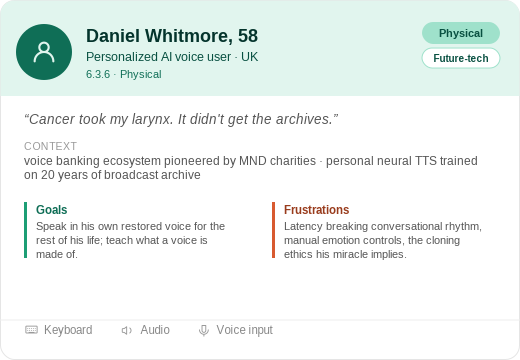
Cancer took my larynx. It didn't get the archives.
Goals
Speak in his own restored voice for the rest of his life; teach what a voice is made of.
Frustrations
Latency breaking conversational rhythm, manual emotion controls, the cloning ethics his miracle implies.
Profile
Daniel Whitmore is a former radio DJ who lost his voice to laryngeal-cancer surgery. But from 20 years of broadcast recordings made before the operation, AI has restored his voice. Now, typing text into a tablet, he can speak in his own original voice. He teaches aspiring voice actors and lives a new life.
Technology Environment
- AI voice model: personalized neural TTS
- Input: tablet, keyboard, whisper-based voice recognition
- Emotion control: real-time adjustment of tone, speed, emphasis
- Voice banking: continuously collecting more recording samples
Daily Scenario
At 10 a.m. Daniel begins a class at a voice-acting academy. He types into the tablet, "Hello, today we'll work on conveying emotion." From the speaker comes that distinctive smooth voice listeners knew from the radio 20 years ago.
# Daniel's AI voice-restoration system
class PersonalizedVoiceAI:
    def __init__(self):
        self.voice_model = {
            'training_data': {
                'hours_recorded': 10000,     # 20 years of broadcast material
                'quality': 'broadcast_grade',
                'emotions_captured': ['neutral', 'happy', 'sad', 'excited', 'serious', 'humorous', 'empathetic']
            },
            'model_specs': {'type': 'neural_tts_transformer', 'parameters': '500M', 'fine_tuning': 'continuous', 'latency': '<100ms'}
        }

    def real_time_synthesis(self, text, emotion_params):
        """Real-time speech synthesis."""
        return self.synthesize(text, {
            'prosody': {'pitch': emotion_params.get('pitch', 1.0), 'speed': emotion_params.get('speed', 1.0)},
            'emotion': {'primary': emotion_params.get('emotion', 'neutral'), 'intensity': emotion_params.get('intensity', 0.7)},
            'voice_age': {'target_age': emotion_params.get('age', 'current'), 'options': ['30s', '40s', '50s', 'current']}
        })
In class a student says, "Your voice is so natural—I can't believe it's AI." Daniel smiles and types, "Thank you. Hahaha." The AI reproduces even his distinctive laugh perfectly.
// Daniel's advanced voice-control interface
const advancedVoiceControl = {
  emotionControl: {
    slider_interface: { happiness: 0.8, seriousness: 0.2, energy: 0.6, warmth: 0.9 },
    quick_presets: [
      { name: 'Radio DJ', settings: { warmth: 1.0, energy: 0.8 } },
      { name: 'Lecture', settings: { clarity: 1.0, authority: 0.7 } },
      { name: 'Casual chat', settings: { casual: 0.9, natural: 1.0 } }
    ],
    live_preview: true
  },
  scriptMarkup: {
    emphasis: '*emphasize this*',
    pause: '... (0.5s pause)',
    emotion: '[joy] say this happily',
    speed: '<slow>speak slowly</slow>',
    whisper: '{{in a whisper}}'
  },
  voiceEvolution: {
    new_recordings: 'whispered_speech',
    quality_improvement: 'ongoing',
    personalization: { catchphrases: ['Right, then', 'everyone', 'well now'], speech_patterns: 'preserved' }
  }
};
In the afternoon, Daniel meets old broadcasting colleagues. Wanting to trade jokes like before, he types pre-prepared lines: "Hey, remember that whole episode? Hahaha." The AI reproduces his playful tone perfectly, and everyone is amazed.
In the evening, Daniel reads a fairy tale to his grandson. Just as he used to give each character a different voice, he adjusts the AI settings to create a range—a low voice for Grandpa Bear, a high one for Baby Rabbit. His grandson cheers, "Grandpa's voice is the best!"
Future Impact
- Full emotional expression: the AI analyzes the emotion in the text and automatically adjusts intonation and tone, so Daniel can hold a natural conversation.
- Real-time interaction: with almost no latency, even phone calls feel natural—the other person doesn't realize it's an AI voice.
- Evolving voice: the AI keeps learning, reflecting even age-related voice changes, so Daniel has a 'living' voice of his own.
Design Implications
- Maximize personalization: learn the individual's speech habits, intonation, and quirks.
- Rich emotion: express even subtle emotional shifts.
- Ethical use: clone a voice only with the person's consent.
- Continuous improvement: keep updating the model with new recordings.