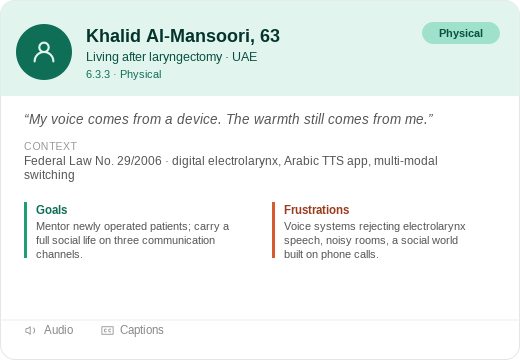
Khalid Al-Mansoori
Living after laryngectomy
UAE · MENA · Age 63
- Law
- Federal Law No. 29/2006
- Services
- UAE PASS
- Messaging
Assistive Technology
- Audio
- Captions
My voice comes from a device. The warmth still comes from me.
Goals
Mentor newly operated patients; carry a full social life on three communication channels.
Frustrations
Voice systems rejecting electrolarynx speech, noisy rooms, a social world built on phone calls.
Profile
Khalid Al-Mansoori uses an electrolarynx after his vocal cords were removed for laryngeal cancer. His voice is mechanical, but communication is no problem, and he serves as a mentor for patients who have had the same surgery. He skillfully uses a range of AAC technologies.
Technology Environment
- Electrolarynx: latest digital model, adjustable pitch
- TTS app: natural-sounding speech generation
- Video calls: live-caption generation
- Voice bank: a recording of his voice from before surgery
Daily Scenario
At 9 a.m. Khalid meets a newly post-laryngectomy patient at the hospital rehab center. Holding the electrolarynx to his throat, he says, "Hello, I had the same surgery two years ago." It's a mechanical voice, but it comes through clearly.
When the patient struggles with the electrolarynx, Khalid takes out a tablet. He types into a TTS app, "It's hard at first, but you'll get used to it soon. I'll help you," and plays it in a smooth AI voice.
# Khalid's multimodal communication system
class MultiModalCommunication:
    def __init__(self):
        self.methods = {
            'electrolarynx': {
                'pros': ['immediate', 'portable', 'no_tech_needed'],
                'cons': ['robotic_sound', 'requires_practice', 'battery'],
                'best_for': ['face_to_face', 'short_conversations']
            },
            'tts_app': {
                'features': {'saved_phrases': True, 'emotion_control': ['neutral', 'happy', 'emphatic'], 'speed_control': range(80, 120)},
                'best_for': ['phone_calls', 'presentations']
            },
            'text_based': {'advantages': ['clarity', 'no_sound_needed'], 'best_for': ['noisy_environments', 'complex_topics']}
        }

    def select_method(self, context):
        """Pick the best method for the situation."""
        if context['noise_level'] > 70:        # dB
            return 'text_based'
        elif context['formality'] == 'high':
            return 'tts_app'
        elif context['urgency'] == 'high':
            return 'electrolarynx'
        return self.user_preference
In the afternoon Khalid video-calls his grandson. The electrolarynx sounds more distorted through a speaker, so he turns on live captions; as he speaks, captions appear at the bottom of the screen so his grandson understands easily.
// Khalid's remote-communication setup
const remoteCommunicationSetup = {
  videoCall: {
    audio: { noise_suppression: 'off', echo_cancellation: 'moderate', volume_boost: true },  // off prevents electrolarynx distortion
    visual: { auto_captions: true, caption_settings: { size: 'large', background: 'black', accuracy_mode: 'medical_terms_aware' }, face_focus: true },
    backup: { chat_panel: 'always_visible', quick_phrases: ['One moment', "Let me say that again", "I'll use chat"] }
  },
  phoneAlternatives: {
    relay_service: 'text_to_voice_relay',
    pre_recorded_messages: {
      voicemail: "Hello, this is Khalid. Please reach me by text.",
      emergency: "I had a laryngectomy and use an electrolarynx."
    },
    sms_preference: { auto_reply: "I prefer text over calls", templates: true }
  }
};
In the evening, Khalid gives a talk at a laryngectomy patients' group. For the 20-minute presentation he pre-recorded his script with TTS, adding spontaneous comments with the electrolarynx here and there to engage the audience.
Challenges & Strategies
- Voice quality: the electrolarynx sounds mechanical and conveys emotion poorly. Khalid relies heavily on facial expression and gesture.
- Noisy environments: in loud places the electrolarynx is hard to hear. He keeps written notes and a text app ready.
- Device dependence: communication is hard if the battery dies. He always carries a spare battery and charger.
Design Implications
- Support varied input: AI that also recognizes electrolarynx speech.
- Custom voice: TTS that reflects the individual's characteristics.
- Fast switching: smooth transitions among several communication methods.
- Medical-info integration: auto-provide medical information to responders in emergencies.