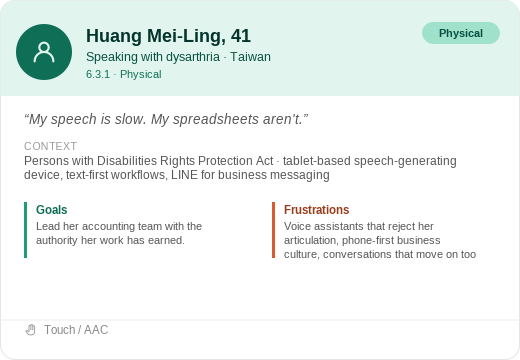
Huang Mei-Ling
Speaking with dysarthria
Taiwan · East Asia · Age 41
- Law
- PWD Rights Protection Act
- Services
- MyData TW
- Messaging
- LINE
Assistive Technology
- Touch / AAC
My speech is slow. My spreadsheets aren't.
Goals
Lead her accounting team with the authority her work has earned.
Frustrations
Voice assistants that reject her articulation, phone-first business culture, conversations that move on too fast.
Profile
Huang Mei-Ling is an accountant with dysarthria from cerebral palsy. Her speech is slow and her articulation unclear, but document work and digital communication pose no problem at all. She mainly uses an AAC device and text-based communication, and her recognized ability earned her a promotion to team lead.
Technology Environment
- AAC: tablet-based speech-generating device (SGD)
- Software: predictive text, saved frequent phrases
- Work tools: messaging, email, video-meeting chat
- Voice recognition: training a personalized voice model
Daily Scenario
At the 9 a.m. team meeting, Mei-Ling has pre-entered her points into the AAC device. When her turn comes, the device speaks: "I'll report this quarter's financial status." In a clear synthetic voice she conveys the numbers and data precisely.
// Mei-Ling's AAC communication system
const aacCommunicationSystem = {
  vocabularySets: {
    work: {
      categories: ['accounting terms', 'running a meeting', 'small talk', 'feedback'],
      quickPhrases: [
        "One moment please, I'm typing",
        "I have a question",
        "Let me share my opinion",
        "Understood",
        "I need more explanation"
      ],
      templates: {
        financialReport: "As of [date], [item] is [amount]",
        approvalRequest: "I request approval for [item]",
        runMeeting: "Let's move to the next agenda item"
      }
    },
    social: {
      greetings: ['Hello', 'Good morning', 'Thanks for your work'],
      responses: ['Yes', 'No', 'One moment', 'Could you repeat that']
    }
  },
  prediction: { wordLevel: { algorithm: 'frequency_recency_combined', personalization: true, context_aware: true } },
  voiceOutput: { speed: 'adjustable_120_to_180_wpm', pitch: 'female_professional', emphasis: 'manual_control' }
};
In a video meeting with a client, Mei-Ling combines two methods: for simple responses she uses pre-recorded clips of her own voice, and for complex explanations she types in live chat while sharing materials on screen.
# Mei-Ling's hybrid communication strategy
class HybridCommunication:
    def select_method(self, context):
        """Choose the best method for the situation."""
        if context['urgency'] == 'high' and context['complexity'] == 'low':
            return 'pre_recorded'      # frequent phrases, clear and consistent
        elif context['formality'] == 'high':
            return 'text_to_speech'    # personalized neural voice
        elif context['environment'] == 'noisy':
            return 'text_only'         # messaging / chat
        else:
            return self.evaluate_energy_level()
In the afternoon, Mei-Ling leads new-employee training. She writes detailed speaker notes on the slides and presents via the AAC device. When questions come, she gives a quick "Good question. I'll type my answer," then composes a calm reply.
Challenges & Strategies
- Time pressure: AAC entry is slower than natural conversation. Mei-Ling prepares predictable situations in advance and keeps spontaneous exchanges short and clear.
- Voice-recognition systems: unclear articulation means she can't use AI voice assistants. She finds alternatives through text input or accessibility settings.
- Phone calls: voice calls are hard, limiting some work. She prefers text-based channels and uses a relay service when truly necessary.
Design Implications
- Multiple input modes: support text, symbols, and gesture input, not just voice.
- Time leeway: remove response-time limits, show an 'is typing' indicator.
- Integrated communication: smooth interoperability between AAC and ordinary apps.
- Personalization: learn each user's vocabulary and articulation patterns.