Jordan Avery
UX designer seeking robotaxi independence
USA · North America · Age 34
- Law
- ADA · Section 508
- Services
- Login.gov / state portals
- Messaging
- iMessage · WhatsApp
Assistive Technology
- Standard UI
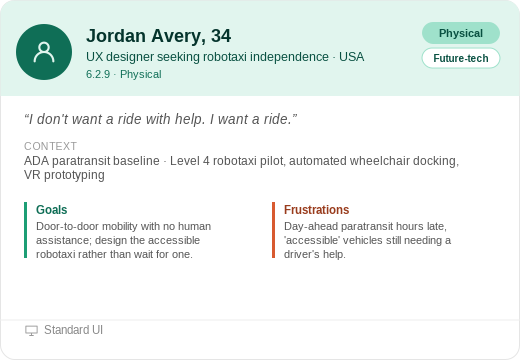
I don't want a ride with help. I want a ride.
Goals
Door-to-door mobility with no human assistance; design the accessible robotaxi rather than wait for one.
Frustrations
Day-ahead paratransit hours late, 'accessible' vehicles still needing a driver's help.
Profile
Jordan Avery is a UX designer who uses a powered wheelchair after a spinal-cord injury. Acutely aware of the limits of today's paratransit systems, they design accessible mobility for the era of full autonomy. They serve as a beta tester for an autonomous wheelchair taxi in pilot operation.
Technology Environment
- Current: paratransit app, public-transit accessibility app
- Testing: Level-4 autonomous vehicle, wheelchair docking system
- Design tools: accessibility simulator, VR prototyping
- Research: user-experience data collection, AI voice interfaces
Daily Scenario
At 10 a.m. Jordan calls an autonomous taxi. Unlike traditional paratransit, it can arrive within five minutes. Selecting "wheelchair user, powered, large" in the app assigns a suitable vehicle.
# The autonomous wheelchair-taxi system Jordan designed
class AutonomousWheelchairTaxi:
    def __init__(self):
        self.accessibility_features = {
            'entry': {'ramp': 'auto_deploy', 'width': '90cm_min', 'slope': '1:12_max', 'surface': 'anti_slip'},
            'interior': {'wheelchair_space': '130x75cm', 'turning_radius': '150cm',
                         'securing': 'auto_docking_system', 'manual_override': 'always_available'},
            'controls': {'primary': 'voice_commands',
                         'backup': 'touch_panel_adjustable_height',
                         'emergency': 'physical_button_multiple_locations'}
        }

    def boarding_sequence(self):
        """Automated boarding sequence."""
        return [
            self.vehicle_positioning(),   # auto-align to optimal position
            self.deploy_ramp(),           # ramp auto-deploys
            self.clear_path_guidance(),   # AR path guidance
            self.auto_docking(),          # automatic securing
            self.safety_verification(),   # safety check
            self.comfort_adjustment()     # temperature, music, etc.
        ]
When the vehicle arrives, it recognizes Jordan's wheelchair automatically, stops at the precise spot, and deploys the ramp. "Welcome, Jordan. Is your destination the downtown startup campus?" After a voice confirmation, the wheelchair rolls in.
Inside, the wheelchair is secured by an auto-docking system—electromagnets combined with a physical lock, safe even under hard braking. "Lower the AC by two degrees," Jordan says, setting a comfortable environment.
On the move, Jordan tests the vehicle's accessibility features in real time and logs feedback: "Docking response excellent, but the lock-confirmation tone is too quiet—add a visual indicator." Five minutes from the destination, the system announces: "Arriving soon. A step-free route to the building entrance is confirmed; the elevator is currently in service." Being able to prepare in advance is reassuring.
Future Impact
- Available on demand: paratransit waits that now take 1–2 hours shrink to 5–10 minutes. Jordan gains mobility equal to a non-disabled person's.
- Full independence: they can board and alight safely without a driver's help, moving freely without feeling beholden to anyone.
- Predictable service: the AI learns usage patterns and waits in advance at commute times, suggesting optimal trips linked to Jordan's schedule.
Design Implications
- True autonomy: every step automated, with no need for human help.
- Embrace diversity: compatibility with a range of wheelchair sizes and assistive devices.
- Safety first: redundant safety systems and manual-control options.
- Data-driven improvement: continuous updates from user feedback.