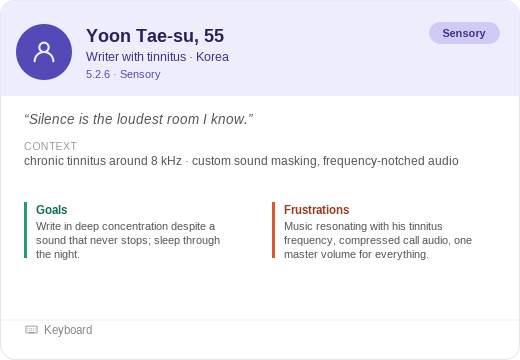
윤태수 · Yoon Tae-su
Writer with tinnitus
Korea · East Asia (Korea) · Age 55
- Law
- 장차법 · KWCAG 2.2
- Services
- 정부24 / 카카오·토스
- Messaging
- KakaoTalk
Assistive Technology
- Keyboard
Silence is the loudest room I know.
Goals
Write in deep concentration despite a sound that never stops; sleep through the night.
Frustrations
Music resonating with his tinnitus frequency, compressed call audio, one master volume for everything.
Profile
Yoon Tae-su is a writer with chronic tinnitus—a high-pitched noise he hears 24 hours a day. The tinnitus is louder when it's quiet, making it hard to concentrate, yet noisy environments make it worse too. He uses a variety of sound-masking techniques to focus on writing.
Technology Environment
- Sound therapy: white-noise apps, nature-sound generators
- Audio gear: noise-cancelling headphones, bone-conduction speakers
- Workspace: acoustically treated home office
- Media: per-track control of background-music volume
Daily Scenario
At 6 a.m. Tae-su wakes at the quietest time of day—but the quieter it is, the louder the ringing in his ears. He turns on a white-noise app and plays rain at a moderate volume: too loud is tiring, too soft and the tinnitus breaks through.
# Tae-su's tinnitus-management sound profile
class TinnitusManagement:
    def __init__(self):
        self.tinnitus_frequency = 8000  # Hz, individual tinnitus pitch
        self.masking_sounds = {
            'morning': {
                'type': 'pink_noise',
                'volume': 45,  # dB
                'frequency_notch': self.tinnitus_frequency
            },
            'writing': {
                'type': 'rain_sounds',
                'volume': 50,
                'mix': ['rain', 'distant_thunder']
            },
            'reading': {
                'type': 'brown_noise',
                'volume': 40,
                'eq_setting': 'low_pass_filter'
            },
            'sleep': {
                'type': 'custom_mix',
                'elements': ['ocean_waves', 'crickets'],
                'volume_fade': 'decrease over 60 minutes'
            }
        }
Referencing video material while writing is the hardest part. When a video's background music resonates with his tinnitus at a certain frequency, the discomfort is severe. Tae-su fine-tunes YouTube audio with a browser extension.
In the evening, Tae-su joins an online writers' group. The compressed audio of the video call irritates his tinnitus and brings on a headache—high-frequency noise like mic hiss or keyboard clatter is especially painful. He applies a noise gate and a low-pass filter during the meeting.
Challenges & Strategies
- Reduced concentration: the constant ringing interferes with his thinking. Tae-su builds custom soundscapes that avoid his tinnitus frequency.
- Auditory hypersensitivity: he becomes extremely sensitive to certain sounds. He catalogs trigger sounds and filters them out.
- Sleep disruption: the tinnitus feels louder at night, causing insomnia. He uses sound apps with a sleep timer.
Design Implications
- Frequency filtering: an equalizer that removes specific frequency bands.
- Sound customization: masking sound matched to an individual's tinnitus profile.
- Gradual volume control: prevent abrupt changes in sound.
- Multi-layer audio: separate control of background, dialogue, and effects.